In What Aspects Hot Work Steel Is Better Than Cold Work Steel?

Categories
Uncategorized

In What Aspects Hot Work Steel Is Better Than Cold Work Steel?

Loading

In steel manufacturing industries, there are various varieties of steels and alloys are used. The use of a particular type of steel depends on the equipment to be made from it. From the various varieties, hot work steel and cold work steel are the popular ones for manufacturing various steel equipment. How does hot work steel differ from cold work steel? Hot work steel is superior to cold work tool steel primarily in high-temperature applications. It offers superior heat checking resistance, hot strength and thermal fatigue resistance. Hot work steel maintains its hardness even at high temperature applications. This makes it a better choice for forging, die casting and extrusion while providing superior toughness and shock resistance. Let’s discuss in detail how hot work steel is better than brittle cold work steel options in this blog.

Key Advantages of Hot work steel Over Cold work tool steel:

  • Heat resistance: High temperature performance refers to a material’s ability to maintain strength and functionality while being exposed to intense heat. Hot work steel, because of its high temperature bearing capacity, is extremely heat-resistant. This type of steel maintains its hardness even at high temperatures, which makes it suitable for manufacturing various equipment. It is suitable for various industrial applications performed at different temperatures, while cold-worked steel softens and is not suitable at high temperatures. 
  • Thermal fatigue resistance: Resistance to thermal fatigue is a material’s bearing capacity to repeated, rapid or extreme temperature changes without developing any cracks or deformation to the metal. Hot work steels like H13 have high temperature yield strength because of their thermal fatigue resistance. This steel type has high hot-yield strength and resistance to softening at increased temperature, and performs best for enhancing thermal fatigue resistance. The hot work steel has high tempering resistance, which is crucial to prevent strength loss during repeated heating cycles.
  • Extreme toughness and ductility: Hot work steel is specially designed to have an extreme level of toughness and adaptability at high working temperatures. These two are the important properties for measuring a material’s behaviour under extreme stress. These properties measure resistance to damage under high load and determine how much a material can stretch or deform without any damage. It is an essential requirement for processes like forging and casting in manufacturing industries. It has lower carbon content compared to cold work steels, which makes hot work steel offer greater toughness and resistance to cracking under high impact load.
  • Thermal shock resistance: Hot work steel provides outstanding thermal shock resistance, which is important for surviving rapid changes between heating and cooling processes. It is the capability of the metal to bear sudden temperature changes, which helps in preventing premature cracking and failure due to thermal fatigue. The key materials that have high thermal shock resistance in hot work steel include AISI H13 and similar grades, which are designed to maintain hardness while resisting heat checking. 
  • Reduced Internal Stress: To reduce or remove the internal stress created in the metal, the technique used for this is called the stress-relieving technique. These stresses can be caused in different ways, ranging from cold working to non-uniform cooling. Stress relieving is usually trained by heating a metal below the lower critical temperature and then cooling evenly. The cold-worked materials can have internal stresses from shaping at room temperatures, but hot-worked steel is processed at higher temperatures, which often reduces internal stresses.

Conclusion

In conclusion, hot work steel is the perfect choice for high temperature and high impact environments like forging, extrusion and die casting. In this steel type, the tools must withstand the heat exceeding three hundred degrees Celsius without softening. In contrast, cold work steel offers good precision and hardness at room temperature, but it is not suitable for hot repetitive applications. Because the cold steel will lose its strength and crack at high temperatures, leading to premature failure. Therefore, Bk Steel Company specially uses hot work steel for manufacturing various applications, which is designed to handle thermal fatigue. We make sure that our steel products are made smoothly without any premature failure under the guidance of our expert, Mr. Manish Maddan

FAQs 

  • Why does hot-worked steel not crack under high stress?

This is because it has the ability of high toughness and ductility. It helps to prevent brittle failure during heavy-duty and high-temperature operations. 

  • Can I use cold-work steel for hot forging?

No, cold-worked steel will lose its hardness. It will become soft and fail prematurely due to poor high-temperature strength and thermal shock resistance.

Categories
Uncategorized

Recycling And Circular Economy:The Production Of Steel

Loading

Steel production was not introduced today; it dates back to when people in India traded wootz steel. As evolution began, so did steel manufacturing, although India used to produce only iron and import steel then. Let us look at the iron and steel industry’s production and discuss its growth, market, and everything related.


Iron And Steel Industry

The steel industry has a ray of hope because of its constant operation, machinery, techniques, and improvement in sustainability. A great improvement in the iron and steel industry is being shown. Steel production has advanced in India over the years, from the early years of importing steel to the present day, when it is the second largest steel producer, which shows the rapid and significant growth in the steel industry.


Procedures for Iron Production

Iron production typically involves reducing iron ore using carbon in a blast furnace to draw out metallic iron. Iron production uses many raw materials such as coke, limestone, and iron ore. These raw materials must go through certain processes, such as blast furnace processes, to obtain iron.

  • Loading is when pellets of iron ore, sinter, lime and dolomite are thrown into the furnace. It is a large vertical refractory furnace that converts iron ore into molten iron.
  • Reduction is when hot air or gas is blasted into the furnace, which reacts with coke, producing carbon monoxide, a strong reducing agent.
  • Smelting-carbon monoxide reacts with iron oxides in the iron ore, reducing it to molten metallic iron. 
  • Slag formation is an impurity formed from molten iron ore and limestone. It floats on the surface after the production of molten iron and is removed.
  • Molten iron-finally, when iron melts, the iron with a higher percentage of carbon is removed for steel production.

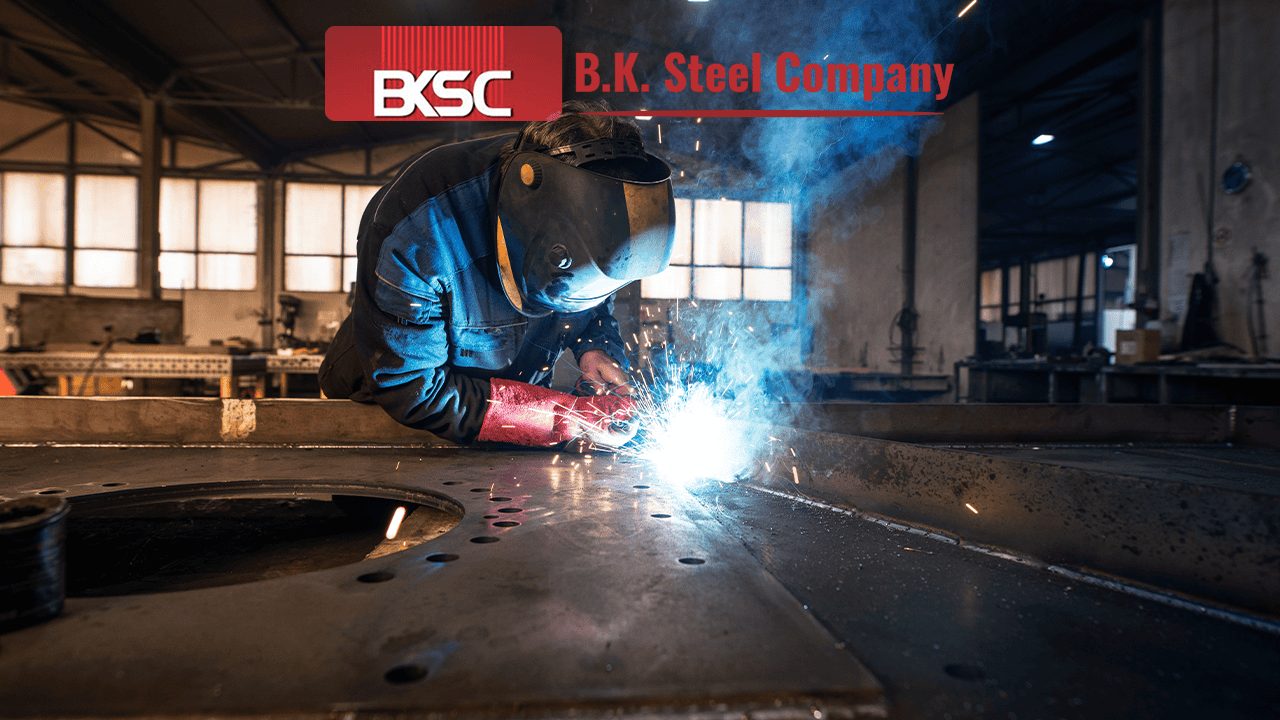
Welding steel in a manufacturing plant for B K Steel Company.

Stainless Steel

Steel is an alloy of iron and carbon with increased strength, durability and corrosion resistance. Steel does not rust easily and has nickel and molybdenum elements, making it much more potent. Some processes, such as heat treatment, are done during steel manufacturing. Heat treatment is done for various reasons, such as improving mechanical properties, enhancing ductility and hardness and increasing hardness and strength. There are different types of stainless steel, ranging from their compositions and properties.


Steel Market In India

The steel market, while rapidly developing, requires you to stay on your toes and on the pulse to foretell the trends in quality or anything in addition to the business’s success. Companies are participating in the investments and research of steel to make provisions for creative and highly innovative products for modern manufacturing needs. The Iron and Steel Industry has proved highly competitive and dynamic because these steel products are primarily used for industry segments such as infrastructure and tools.

Some factors, like the economy’s expansion and urbanisation, have also led to the high demand for steel. At BK Steel, we have a variety of modern infrastructure that helps us manufacture quality products and cater to consumer preferences.BK Steel has all your steel and iron-related products.

Categories
Uncategorized

What are the steel suppliers, and what are their key aspects?

Loading

Steel dealers are those persons who are responsible for buying and selling steel. They provide dealing of steel from one company to another. In Punjab, there are a number of steel dealers available who provide trading of steel from the making industry to the company.

Many people from outside of the state come to Punjab to purchase steel. Buying and selling of steel mostly take place from the best Steel Dealers in Punjab.

Various Types of Steels available in India

Carbon Steel: Carbon steel is of three types as mentioned under:-

  • High-carbon steel has a very high amount of carbon available. It is used for making hard and strengthful materials like axes, blades, knives, etc.
  • Medium-carbon steel has a medium amount of carbon available. It is used to make the steels that are used for structural applications like components of automobile and computer hardware components.
  • Low-carbon steel has a low amount of carbon available. It is used to make metal sheets that are used in the house renovation.

Alloy Steel: Alloy steel is a very commonly used steel in India. As it provides features like heat resistance, rust-free and strength.

High Strength steel: High-strength steel is a metal that is used for high-strength purposes. It has high strength, so that it is difficult to break it. For example, these steel metals are used for making different things in the aerospace, construction and automobile industries.

What are steel suppliers and their key aspects?

Steel suppliers are the companies and industries that make, deliver and sell the bulk load of steel from business to business service.

Carbon alloy steel is in very high demand in India, and there are many suppliers of carbon alloy steel available in India. For the best Carbon Alloy Steel Suppliers in India, you can search for various popular suppliers. 

Here are some key aspects of steel suppliers:-

    • Quality Product: Steel suppliers ensure that they provide high-quality steel for the consumers. They also give the necessary certification along with the buying of steel. 
    • Cost-effective: Steel suppliers provide a very cost-effective steel to the consumers. They provide low-budget steel to the consumer so that every consumer can afford steel for their own purposes.
    • Environment-friendly: Steel suppliers ensure that the steel should be eco-friendly. Some staff members do not consider it, but it is very important for the environment.
  • Different products: Steel suppliers provide different high-quality products like sheets, rods, utensils, and other steel alloys. Also, their prices may vary according to the product for the consumers.
  • Delivery services: Steel suppliers provide delivery services also for the consumers and the companies according to their preferences.

Conclusion

It is very important to buy good quality steel from reputed steel suppliers. Choosing the best steel company is to be your priority. Please contact BK Steel Company to purchase good quality and affordable steel.